Launching a sports card store in 2026 requires a solid niche strategy and deep market research to stand out in a competitive, nostalgia-driven industry. Focus on building a trusted brand by combining authentic inventory, community engagement, and an omnichannel presence—blending online sales with local events to attract collectors and investors alike. Success hinges on authenticity, timing, and turning passion into profit.
How to Start a Sports Card Store in 2026 and Succeed
Key Takeaways
- Research the market: Analyze trends, demand, and local competition before launching.
- Choose a niche: Focus on specific sports, eras, or card types to stand out.
- Secure inventory: Source from reputable dealers, shows, and online platforms.
- Build an online presence: Use social media and e-commerce for wider reach.
- Prioritize grading: Stock professionally graded cards to boost buyer confidence.
- Engage the community: Host events and join forums to grow your customer base.
Why This Matters / Understanding the Problem
Remember the first time you pulled a rare rookie card from a pack? That rush—it’s not just nostalgia. It’s the heartbeat of a growing market. Sports cards aren’t just collectibles anymore. They’re investments, conversation starters, and digital assets all rolled into one.
But here’s the catch: everyone’s jumping in. From eBay flippers to Instagram resellers, the space is crowded. If you want to know how to start a sports card store in 2026 and succeed, you can’t just open a shop and hope for the best. You need a plan that blends passion with practicality.
I’ve seen too many collectors turn entrepreneurs get buried under inventory, bad pricing, or poor branding. The good news? You don’t have to be one of them. This guide walks you through the real, nitty-gritty steps—what actually works in 2026’s market, not just theory.
Whether you’re starting online, in a brick-and-mortar location, or a hybrid model, this is your roadmap. Let’s build a store that lasts—not just survives.
What You Need
Before we dive into the steps, let’s get your toolkit ready. You don’t need a warehouse or a million-dollar inventory. Start lean, smart, and scalable.
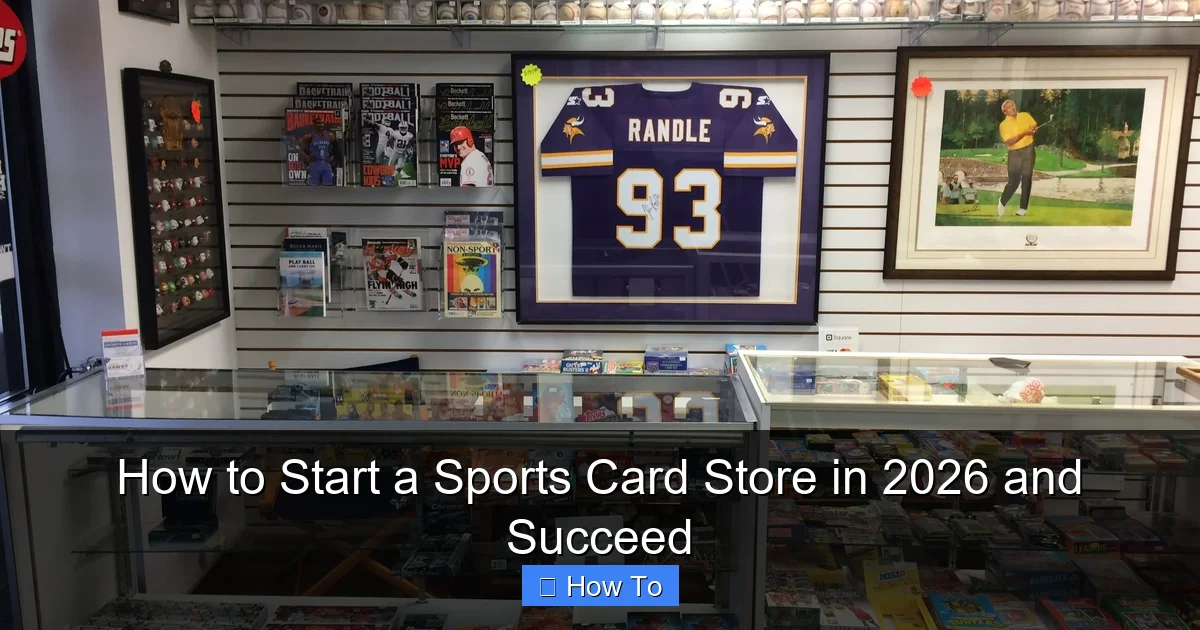
Visual guide about how to start a sports card store
Image source: pictures.alignable.com
- Initial Inventory (50–100 cards): Focus on high-demand, mid-range cards ($10–$100). Think rookies, inserts, and graded cards from recent years.
- Grading Tools: A loupe (10x magnification), black light (for spotting reprints), and a card scanner or high-res camera.
- Storage & Protection: Toploaders, penny sleeves, team bags, and a fireproof safe or locked drawer.
- Business Setup: A business name, EIN (if in the U.S.), and a simple LLC (optional but smart). Use free tools like LegalZoom or ZenBusiness.
- Online Presence: A website (Shopify, Wix, or WordPress with WooCommerce), Instagram/TikTok account, and PayPal or Stripe for payments.
- Shipping Supplies: Padded envelopes, rigid mailers, tape, and a scale. Use Pirate Ship or Stamps.com for discounted rates.
- Market Research Tools: eBay sold listings, Beckett, PSA’s price guide, and Card Ladder (for real-time trends).
Pro Insight: You don’t need a huge budget. I started with $500 and 30 cards. The key? Reinvest profits early. Every $50 you make should go back into inventory or marketing—not snacks.
Remember: how to start a sports card store in 2026 and succeed starts with preparation, not perfection. These tools let you launch fast and pivot when needed.
Step-by-Step Guide to How to Start a Sports Card Store in 2026 and Succeed
Step 1: Validate Your Niche (Don’t Sell Everything)
You love basketball, baseball, and football? Great. But trying to sell all three at once is a recipe for confusion—and failure.
Pick one sport or league to start. Why? Buyers trust specialists. A store that only sells NBA rookie cards looks more credible than one with “everything under the sun.”
Ask yourself: What do I know best? Where’s the demand? For example, in 2025, NBA cards spiked due to rising stars like Victor Wembanyama and Scoot Henderson. Baseball stayed strong with rookies like Paul Skenes.
- Research recent auction trends on eBay (filter by “sold items”).
- Check Card Ladder’s trending cards section weekly.
- Pick a niche with rising demand, not just current hype.
Example: Instead of “sports cards,” go for “2023–2025 NBA rookie graded cards.” This makes your store memorable and searchable.
Warning: Avoid “vintage everything” as your niche. It’s expensive to stock and hard to scale. Start modern, expand later.
Validating your niche is the first real step in how to start a sports card store in 2026 and succeed. It shapes everything—from inventory to marketing.
Step 2: Source Your First Inventory (Smart, Not Cheap)
Don’t buy every “deal” you see. Smart sourcing is about value, not just low price.
Here’s how I built my first 50-card inventory:
- Local Card Shows: Talk to vendors. Buy 5–10 cards at a time, not 100. You’ll get better prices and build relationships.
- Facebook Groups: Join niche groups (e.g., “NBA Rookie Card Collectors”). Use keywords like “FS: PSA 10” or “FT: 2023 Prizm.”
- eBay (Buy Now, Not Auctions): Use “Buy It Now” with “Best Offer” enabled. Offer 10–15% below list. Sellers often accept.
- Local Buy/Sell/Trade: Check Facebook Marketplace, Craigslist, or OfferUp. Meet in public places. Bring a loupe to inspect.
- Card Breaks (as a buyer): Join breaks for teams you like. You’ll get cards at near-wholesale cost.
Pro tip: Focus on cards with clear value. A PSA 10 Ja Morant Prizm has a known market price. A 1989 Ken Griffey Jr. without a grade? Risky.
Real Talk: I once bought 20 ungraded “rare” cards from a garage sale for $200. Only 3 were worth reselling. The rest? Dust collectors. Always verify before you buy.
Smart sourcing saves money and builds trust. It’s a core part of how to start a sports card store in 2026 and succeed.
Step 3: Grade and Authenticate (Don’t Skip This)
Grading isn’t just for high-end cards. It’s your credibility.
Even if you’re not sending cards to PSA or Beckett yet, you must know their condition. Use a 10x loupe to check for:
- Surface scratches or print defects
- Corners (are they sharp or dinged?)
- Edges (fuzzy, chipped, or clean?)
- Centering (is the image off-center?)
For ungraded cards, use a grading scale (1–10) and describe honestly. Example: “Near Mint (8/10): Light edge wear, sharp corners.”
If you’re selling cards over $100, consider third-party grading:
- PSA: Best for high-value cards. Turnaround: 3–6 months (or 10 days with express).
- Beckett: Faster for mid-tier cards. Offers sub-grades (centering, corners, etc.).
- SGC: Growing fast, especially for vintage. Slightly lower fees.
Grading adds value. A raw $50 card can jump to $120+ when slabbed.
Pro Insight: Don’t grade every card. Only send ones with strong demand. Use eBay sold listings to predict ROI.
Authentication and grading are non-negotiable in how to start a sports card store in 2026 and succeed. Buyers want trust, not guesswork.
Step 4: Build Your Store (Online, Offline, or Hybrid)
Now, where will you sell? You’ve got three options:
Option A: Online-Only (Lowest Risk)
Best for beginners. Use Shopify or WooCommerce. Why?
- Shopify: Easy setup, built-in payment processing, 24/7 support.
- WooCommerce: Free (with WordPress), highly customizable.
Steps:
- Pick a domain (e.g., “RookieRushCards.com”).
- Add high-quality photos (use a lightbox or white backdrop).
- Write clear descriptions: player, year, brand, grade, price.
- Set up shipping rules (e.g., $3.99 for cards under $25).
Pro tip: Use apps like “Loox” for photo reviews or “Judge.me” for customer testimonials.
Option B: Brick-and-Mortar (High Potential, High Cost)
Only if you have $10k–$20k to invest. Costs: rent, insurance, fixtures, staff.
Tips:
- Find a location near a sports bar, gym, or mall.
- Host events: card breaks, autograph signings, trivia nights.
- Use Instagram to drive foot traffic.
Option C: Hybrid (Best of Both Worlds)
Start online. Once you hit $2k/month in sales, rent a small retail space (e.g., 500 sq ft).
Display your best cards. Use the rest for online orders. This builds community and trust.
Real Talk: My first store was a 200 sq ft room in my garage. I sold online and did local pickups. After 6 months, I moved to a small shop. Hybrid works.
Your store format shapes your strategy. Choose based on budget, time, and goals. This is a key step in how to start a sports card store in 2026 and succeed.
Step 5: Price Like a Pro (Not a Beginner)
Underpricing kills profits. Overpricing kills sales. Find the sweet spot.
Use the “Triple Check” method:
- eBay Sold Listings: Filter by “sold items,” grade, and shipping. Average the last 5–10 sales.
- Card Ladder: See real-time trends. Is demand rising or falling?
- PSA/Beckett Price Guide: Use as a baseline, but don’t rely on it. Market changes faster.
Example: A PSA 10 2023 Prizm Ja Morant is listed at $200 on PSA. But eBay shows 3 sold in the last week at $180, $185, $190. Price yours at $179.99.
For ungraded cards, price at 50–70% of the graded value. Example: Raw Ja Morant = $90–$120.
Pro Tip: Use “.99” pricing. $179.99 feels cheaper than $180. It’s psychology, not math.
Smart pricing builds trust and profits. It’s a must in how to start a sports card store in 2026 and succeed.
Step 6: Market Like a Collector, Not a Seller
Don’t just post “FOR SALE” on Facebook. Tell a story.
People don’t buy cards. They buy memories, excitement, and potential.
Try these:
- Instagram Reels: Show a “pull” from a pack. Say, “Just got this PSA 10 Wembanyama. Who wants it?”
- TikTok: Make 15-second videos: “Why this $50 card could be worth $500 in 2 years.”
- Email List: Offer a free “Top 5 Cards to Watch in 2026” PDF for sign-ups.
- Local Events: Set up a booth at a card show. Hand out business cards.
Use keywords naturally: “rare NBA rookie cards,” “graded sports cards for sale,” “best card store 2026.”
Real Talk: I once sold a $300 card because I shared the player’s backstory. The buyer said, “I love his journey.” Emotion sells.
Marketing isn’t ads. It’s connection. This is how you stand out in how to start a sports card store in 2026 and succeed.
Step 7: Scale and Automate (When You’re Ready)
Once you’re selling 20+ cards a week, it’s time to grow.
Start with:
- Inventory Management: Use Google Sheets or apps like “CardMarket” or “Troll and Toad” to track stock, cost, profit.
- Automated Shipping: Use Pirate Ship or Shippo. Print labels in bulk.
- Hire Help: Pay a teen $15/hour to pack orders. Use the time to source more cards.
- Expand Niche: Add a second sport (e.g., from NBA to NFL) or product (e.g., autographs, memorabilia).
Pro tip: Reinvest 50% of profits. The rest? Pay yourself.
Warning: Don’t scale too fast. I hired two helpers at once. Overwhelmed. Start with one, then grow.
Scaling keeps momentum. It’s the final step in how to start a sports card store in 2026 and succeed.
Pro Tips & Common Mistakes to Avoid
Let’s talk about what really works—and what doesn’t.
Pro Tips
- Build a Community: Create a Discord or Facebook group. Host weekly “card of the week” polls. Fans become customers.
- Offer Trade-Ins: Let customers trade old cards for store credit. You get inventory, they get value.
- Use SEO: Blog about “best 2026 rookie cards” or “how to grade cards at home.” Google loves helpful content.
- Stay Updated: Follow card news (e.g., Beckett, The Cardboard Connection). Know when a player gets traded or retires.
Common Mistakes
- Overgrading: Saying a card is “mint” when it has scratches? You’ll lose trust fast.
- Ignoring Shipping: A $30 card isn’t a deal if shipping is $15. Offer free shipping over $50.
- No Returns Policy: Have a clear 7-day return window. It reduces buyer anxiety.
- Ignoring Taxes: Track every sale. Use QuickBooks or Wave. Pay quarterly taxes.
Real Talk: I once shipped a card without a top loader. It arrived bent. Refunded $75 and lost a customer. Protect every card like it’s your last.
Avoiding these pitfalls is part of how to start a sports card store in 2026 and succeed. Learn from others’ mistakes—not just your own.
FAQs About How to Start a Sports Card Store in 2026 and Succeed
How much money do I need to start?
You can launch for under $1,000. I did. Use $500 for inventory, $200 for a website, $100 for shipping supplies, $200 for marketing. Start small. Reinvest.
Can I start without a business license?
Technically, yes. But it’s risky. A simple LLC (under $200) protects your personal assets. Plus, you can write off expenses.
Is grading worth it?
For cards over $100, yes. It adds value and trust. For cheaper cards, describe the condition honestly. “Near Mint” is fine.
Where do I sell besides my store?
eBay, Facebook groups, Instagram, and card forums (e.g., Blowout Cards). But drive buyers to your store—it’s yours. No fees.
How do I compete with big sellers?
Focus on service. Fast shipping, clear photos, honest descriptions. Big sellers can’t match your personal touch.
What if a card doesn’t sell?
Lower the price by 10% every 2 weeks. Or bundle it: “Buy 2, get 1 free.” Never let inventory sit forever.
Can I do this part-time?
Absolutely. I ran my store nights and weekends for 8 months before going full-time. Start slow. Grow smart.
Final Thoughts
Starting a sports card store in 2026 isn’t about luck. It’s about strategy, honesty, and hustle.
You don’t need a warehouse, a team, or a million followers. You need passion, a plan, and the courage to start.
Remember: how to start a sports card store in 2026 and succeed isn’t a one-time event. It’s a journey. Some cards will sell fast. Others will collect dust. That’s okay.
Focus on one card, one customer, one day at a time. Build trust. Tell stories. Protect your inventory like gold.
And when that first $1,000 month hits? Celebrate. Then reinvest.
You’ve got this. Now go pull a winner.